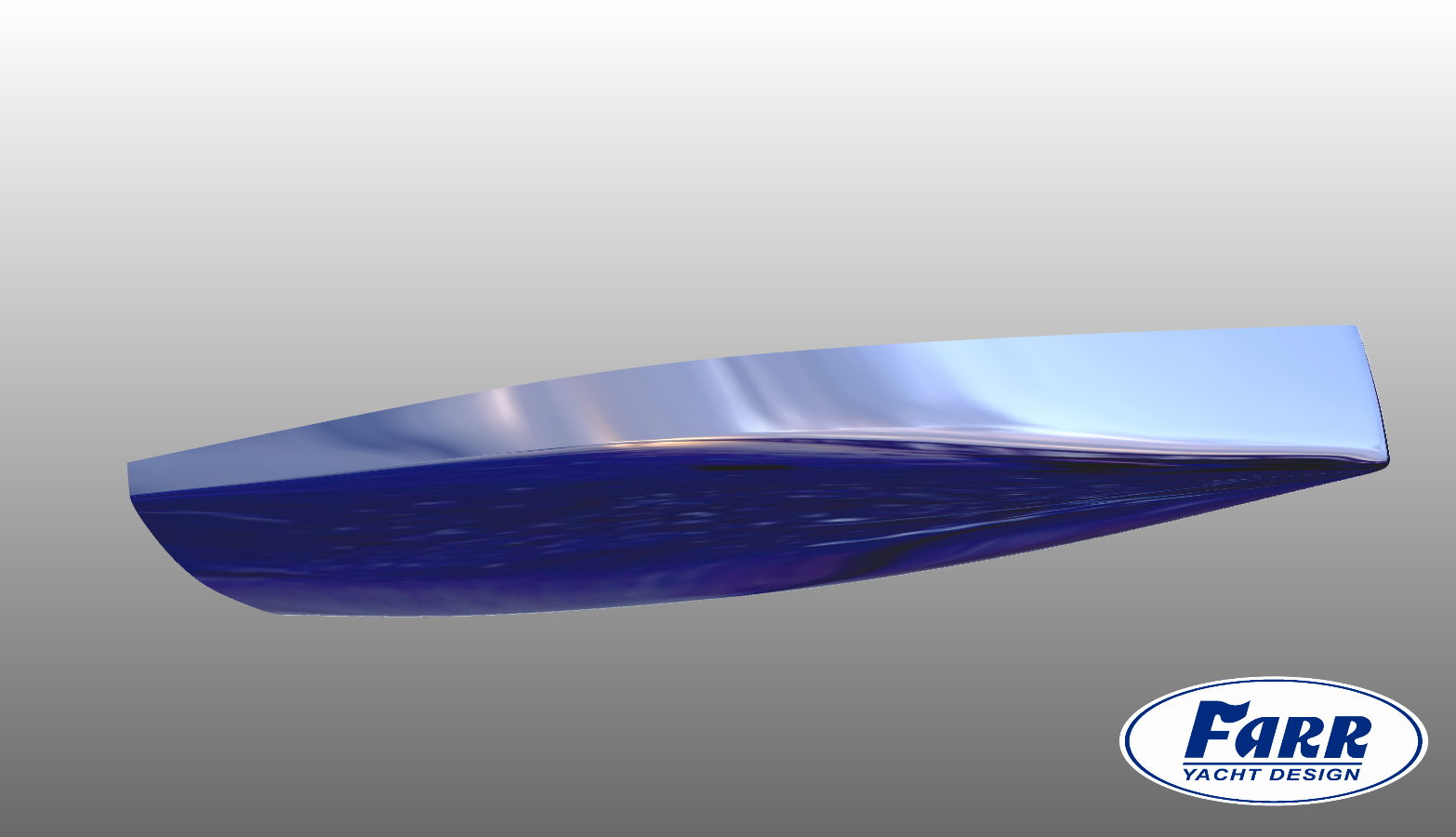
40ft IRC Racing Yacht
Description
Design 780 is a 40ft IRC Racing Yacht concept designed by Farr Yacht Design in 2015. She has an overall length of 40 feet.
Many of our existing designs are performing very well in Australia under the IRC handicap system and we continue to refine our understanding of the rule space to identify areas for improvement. While we are gratified with the success our designs in the Australian market, we are anxious to complete a new design that reflects the recent evolutions of the IRC rule and allow us to show the world the significant improvements we have made in all aspects of yacht design.
Australia has always favored boats that are lighter and more responsive than the typical IRC type form of heavy, narrow boats that have been dominant in a lot of IRC racing in the rest of the world. This is reflective of the types of conditions you sail in so often – strong sea breezes, significant waves and a mix of racing styles that place a premium on a boat that can hold its own upwind but is light enough to plane quickly off the wind and in any reaching conditions. The recent success of the modified TP52’s, GP42’s, Cookson 50’s and Ker 46’s reflect this. We have always felt that the TP52’s are at a very unique place in the IRC universe where they carry sufficient power upwind and have light enough displacement to sail well off the wind and sail to their ratings even in light air. This balance has been harder to achieve at smaller sizes where the performance versus handicap has favored the heavier cruiser racer type form. Our research indicates there has been a softening in the rule space toward lighter boats and that this combined with the special dynamic factors of sailing where you do presents an opportunity for a substantially lighter 40’ to do well under performance versus handicap.
Visual Assets
Technical Specifications
| Year | 2015 |
| Type | Racing Yacht |
| Rule | IRC |
| Tags | Concept |
| LOA | 12.2 m40.03 ft |
| Beam | 4.2 m13.78 ft |
| LWL | 11.25 m36.91 ft |
| Draft | 2.85 m9.35 ft |
| Displacement | 4,400 kg9,700 lbs |
| Ballast | 2,000 kg4,409 lbs |
| Keel Type | Fixed |
| Hull Construction | Composite |
| Headsail Hoist (I) | 16.5 m54.13 ft |
| Foretriangle Base (J) | 4.6 m15.09 ft |
| Main Hoist (P) | 16.57 m54.36 ft |
| Main Foot (E) | 5.27 m17.29 ft |
| Spinnaker Tack Point (STL) | 6.91 m22.67 ft |
| Rig Type | Sloop |
Plans not available — concept design.
Interested in a Farr design?
Whether you’re looking for plans, consulting, or a new project — let’s talk.
Designer’s Notes
Hull Form
With this design we have sought to develop very a low drag hull form that can be driven efficiently by a reasonable sailplan even in light air but has sufficient form and ballast ratio to achieve exceptional performance in moderate to strong breezes. The hull form represents a development of FYD’s extensive race boat development projects and benefits from substantial computational fluid dynamics studies of various hull forms to develop efficient, low drag hulls that are optimized to the expected sailing conditions. Care has been taken to develop a hull shape that maximizes its effective length relative to its rating without adding extra drag at low speeds. This is reflected in the aft overhang and aggressive shaping of the knuckle that act to make the boats rated length as short as possible while engaging as effective waterline length once crew is aboard and the boat is underway. The hull shape utilizes a sophisticated and highly resolved surface description that allows a high level of control in developing both the heeled and upright shape. The rocker curve, bow volume and transom immersions with heel have all been specifically developed to produce a hull shape that will excel in dynamic offshore Australian conditions, maximizing heeled stability but without sacrificing effective length and adding upright wetted surface that could adversely impact light air performance. The boat exhibits a reasonable amount of flare to maximize crew righting moment contributions which are critical at this size range. This is reflected in the deck beam being carried well aft to maximize crew hiking moment when the crew shifts aft in strong winds, particular reaching and running. At 40’ the boat is positioned in length such that 10 crew members are permitted for IRC racing which maximizes the crew weight available.
The hull incorporates a number of signature aesthetic features that give the boat a unique character. The reverse stem and subtly reversed sheer line give the impression of forward speed even at rest and draw comparison to other modern Grand Prix designs.
Sailplan
The IRC rule rates upwind sail area very strongly. One of the core challenges in designing a successful IRC design is selecting sailplan proportions that provide sufficient light air performance and dynamic acceleration without incurring an excessive rating penalty. The selected dimensions target moderate conditions and could be increased or decreased to suit a particular venue’s expected conditions and competition.
The sailplan features twin topmast running backstays and square headed mainsail for improved performance versus rating. The concept mast uses a two spreader layout with 20 degree spreader angle that is ideal for IRC rating and easy rig control. Mast tube construction is carbon to maximize tube stiffness and minimize weight without rating penalty. Sidestays and forestay use nitronic rod as the rating impact for fiber rigging at this size of boat is bigger than the performance benefit. The boat features a generous gennaker flown from a fixed bowsprit. A variety of code 0 and reaching sails may be set from the bowsprit or a fixed tack point located on the stem.
Deck Geometry and Layout
The asymmetric deck layout follows modern Grand Prix race boat practice, for high efficiency and fast maneuvers.
The deck reflects a modern aesthetic and has been designed to allow ergonomically optimized access to all sail controls. The layout features athwartship jib tracks that offer more control over sheeting angle. A tight sheeting angle can be achieved for upwind sailing, while still having the ability to maintain leech control by sliding the car outboard when reaching. The fixed [but removable] sprit allows for a straightforward tackline arrangement and simplified pit setup. The boat features an asymmetric companionway which permits the halyards to be led to a single pit winch on the starboard side of the offset companionway which reduces the winch count. The mainsheet controls (Cunningham, outhaul, and traveler) are led to cockpit pods so that all of the main control lines are within reach of the main trimmer. A primary grinder pedestal system is located aft for weight placement and allows for high speed spinnaker gybes, sail hoists, and string line spinnaker drops. Final positioning of the pedestal needs to be verified depending on steering system and boom length to avoid main sheet entanglement with the pedestal. The vang is led aft to a flip flop block to be closer to main trimmer and backstays Twin topmast backstays on a 2:1 purchase allow for the use of a square head mainsail but can be easily shifted to a single backstay should that configuration be preferred. With minor modifications to the deck layout there is an option for either tiller or twin wheel steering.
Interior Arrangement
The proposed interior arrangement is focused around a light weight racing style interior suitable for offshore sailing, featuring a head in a soft enclosure forward, a simple offshore appropriate galley and an appropriate navigation station.
Appendages
The design features a T-keel planform featuring a lead bulb that offers a low VCG for improved righting moment. The bulb shape is a development of FYD’s computational fluid dynamics based research program into optimum bulb shapes, offers low drag in a wide variety of wind conditions. Draft has been set at 2.85 m which provides a low center of gravity and plenty of upwind lift while being a manageable draft for local marinas. A deeper draft could be considered after assessing the performance versus rating balance and a more detailed analysis of depth restrictions. The selection of keel fin area is a balance between optimizing for low drag (small) and the requirements for extra lift when accelerating from low speeds and when sailing the boat in an upwind “high mode”. For the lightest weight and most cost effective construction we anticipate building the fin from a fabricated steel spar with a composite hydrodynamic fairing. The rudder is a modern, high aspect ratio planform with a carbon stock that helps minimize pitch inertia and provides superior stiffness and strength. The foil sections for both the keel and rudder are custom developed proprietary sections designed to make the boat easy to sail in a straight line, maneuver at the dock or in tight corners around the race course and give the boat wider groove.
Construction
The construction of the boat is designed to comply or exceed the ISO 12215 standards. The structural arrangement reflects FYD’s dedication to producing optimized structural solutions that balance performance, material cost and reduced production time. We anticipate that the hull, deck and structural bulkheads would utilize vacuum consolidated multi-axial E-Glass/epoxy skins with foam cores. We expect the keel structure to be built from E-glass laminated in situ. The internal structure would be engineered from flat panel stock to ease manufacturing. Lightweight interior panels are utilized wherever possible used as structure where necessary to support hull and deck shell, eliminating redundant sub structure and reducing interior weights.
Performance and Rating
It is important for this design that performance is “all around”, without exhibiting weaknesses in any areas. In light conditions, the boat relies on light displacement and moderate sail area to provide good boatspeed, as well as good acceleration. While in stronger upwind conditions, the high ballast ratio, and heeled form stability ensures competitive performance. The displacement is light enough to allow for exciting downwind performance. However, the weight is intended to be realistic for economical construction technology and does not trigger an excessive IRC rating.
We project a 2015 IRC rating of 1.20 - 1.23 pending final weight, sail area and draft selections.